The W / X / R Framework
A model of where value originates in a business and how automation redistributes it.
The framework is descriptive and deliberately open. It supplies categories. The reader maps the relationships among them in their own situation. It does not assume that individuals are valuable to a business. It describes where value originates, how it is attributed, and what automation changes.
Part I: The static model
Notation
The model represents a business as a set of structural objects and defines value on two layers. The structural objects describe how the business is built. The person layer describes what an individual contributes to it. One variable recurs throughout: whether a piece of work can be specified as a process. That variable determines what automation can reach.
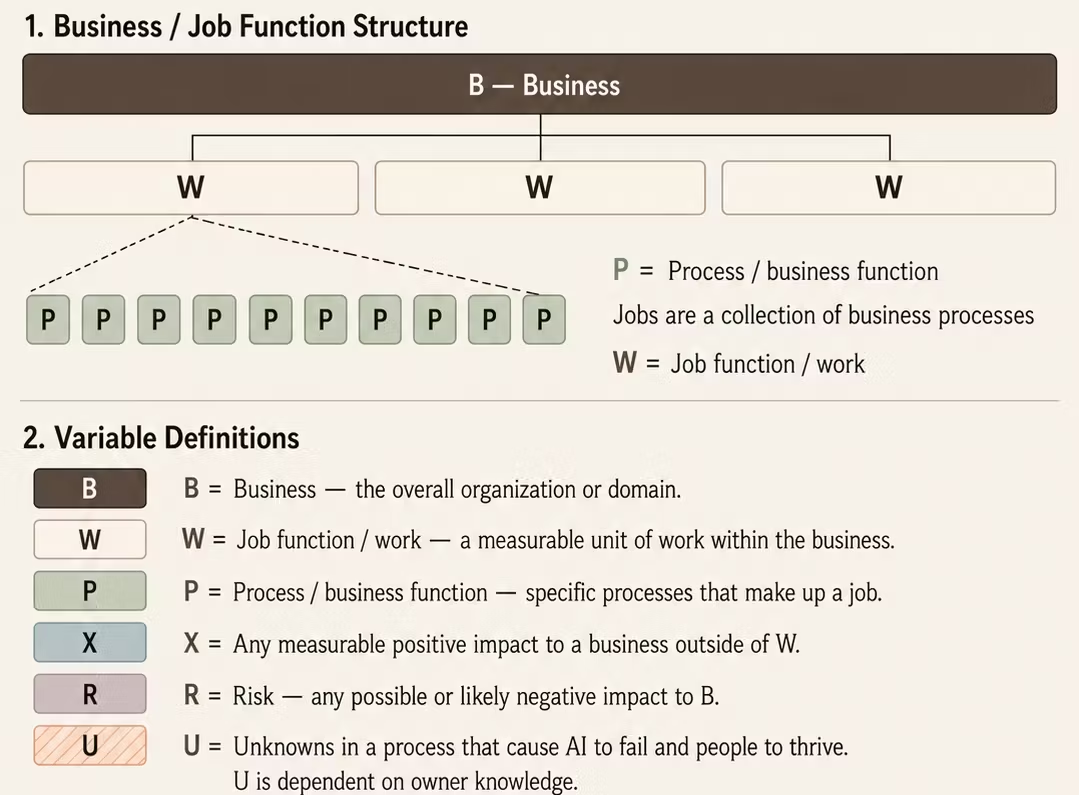
- B (Business). The complete system under analysis: the set of its job functions. B = ΣW.
- O (Owner). The agent that defines the structure of B, including the division of work into processes.
- W (Work, job function). The set of processes that constitute a role, specified independently of any individual who performs it. Execution quality is not part of W. W = ΣP.
- P (Process). A single specifiable business function: the unit of W.
- X (X-factor). Any positive effect on B that an individual produces outside their defined W.
- R (Risk). Any actual or potential negative effect on B attributable to an individual.
- U (Unknown). The portion of W that O cannot reduce to a specified process.
- PX (Process from X). A specifiable process formed from an X that did not exist in the current W.
Structure
A business is the sum of its job functions. A job function is the sum of its processes. B = ΣW and W = ΣP. The division is set by O. Any portion of W that O cannot express as a process is U.
W, X, and R
W is the role itself: the set of processes the function is made of, regardless of who fills it. X and R describe the person in the role. X is the positive effect they have on the business beyond the function. R is the risk. These are three separate things to weigh, not terms in an equation. Sometimes an X carries an R with it. Sometimes the two are unrelated. The framework does not settle that. It supplies the categories so a reader can map how they relate in their own case.
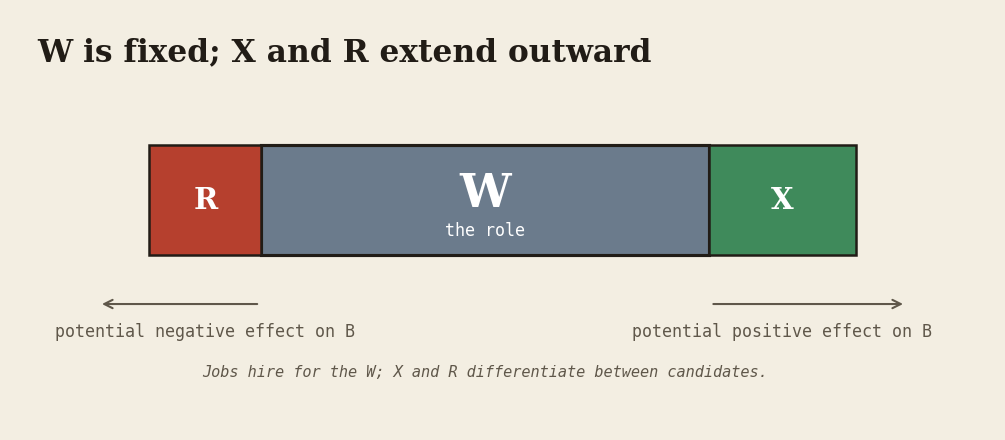
Examples of X: an external network, communication ability, or knowledge that raises the output of others. Higher output within W is not X. More sales or faster resolution is still execution of W. Examples of R: errors that propagate to other roles, exposure of B to legal or reputational liability, or the concentration of an unspecified process in a single individual.
Unlike X, R is more estimable in advance. Attendance, turnover, and liability all have base rates, and candidates can be compared on them. What cannot be priced is the joint outcome, because R is assessed before any X exists. Whether to accept a higher estimated R in exchange for a larger possible X is not a question the framework answers. That choice is organizational preference. Example. A startup may prefer the higher R candidate with the larger potential X. A public agency with no mandate beyond the W may prefer the lowest R candidate available. Both are correct readings of the same variables under different preferences.
The individual and the automated system
Both an individual and an automated system can perform W. They differ in what surrounds it. An individual arrives as a bundle: the work, plus X and R that cannot be fully known in advance. An automated system is the function alone, with values near zero on both. Where a role is valued only on W, the automated system is the known quantity. It is predictable where the individual is variable, and the lower cost adds to the case.
The variables are idealized. They describe the structure of the comparison, not any particular implementation. The asymmetry in R follows from the same fact as the asymmetry in X. An individual exists outside the process, which is the source of X, and their R is therefore unbounded by the process as well. It includes departure, divided interests, interpersonal effects, susceptibility to social engineering, and the fixed costs of employment itself, such as benefits, facilities, variable attendance, and the limits of a working day. These attach to the person rather than the role. They recur with every hire, and on average they cannot be engineered away. An automated system does not exist outside the process. Its failures are process failures: specification gaps, bad inputs, integration faults. Those occur in terms the framework already names, and they are reducible by the same specification work that built the system. A critique that lists the implementation risks of automated systems while treating the individual as an abstraction compares the two at different grains. Held at the same grain, the asymmetry returns. Even uniform failure cuts both ways, because a correction propagates exactly as far as the fault did.
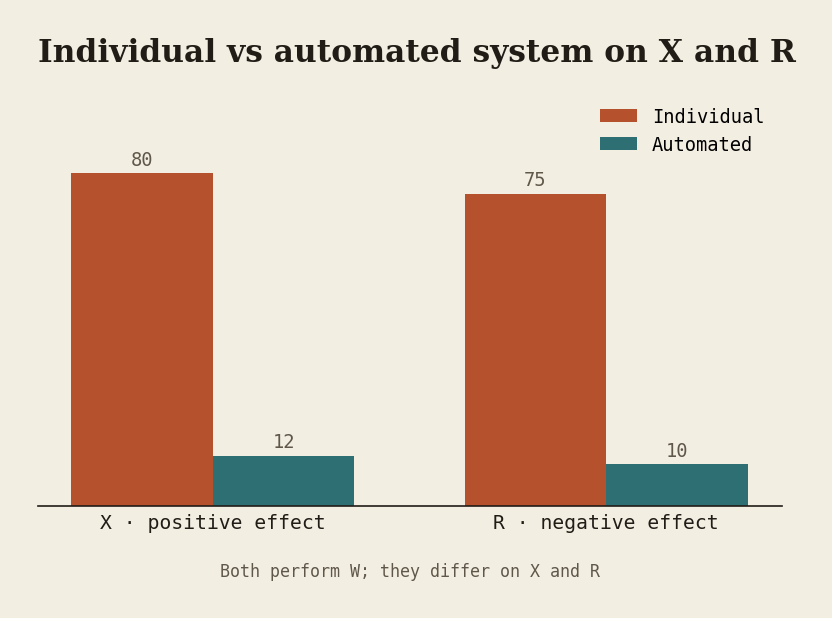
X originates outside the defined process. An automated system operates only on the inputs it is given. An individual receives continuous, unselected input from the environment and can convert further observation into X at any time. The model treats this as the source of X and treats it as unbounded. It does not imply that any particular individual possesses X.
U
U is the portion of W that O cannot reduce to a specified process. It is measured relative to O's knowledge, not the individual's, and it exists inside W by definition. U is a property of how the business's own work is specified, not of the work's novelty. U has more than one source. A common case is delegation, in which O assigns a function without acquiring the ability to specify it. U is a neutral quantity. It denotes a gap in specification, not a deficiency in any individual. The limiting case is a W with no U at all, meaning every process is specified. That is the end state toward which an automation-first business converges.
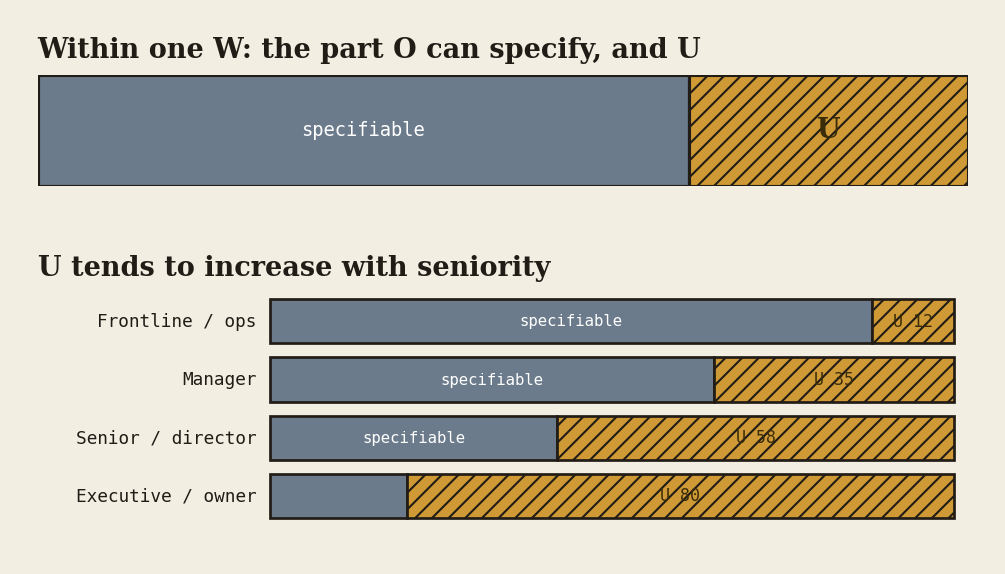
U tends to increase with organizational seniority. Higher roles consist of less specifiable work, so a larger share of W resists reduction to process. Low specifiability is frequently treated as evidence of expertise. The framework proposes that specifiability is the variable relevant to automation, not seniority.
Part II: Behavior over time
Part I describes the static model. Part II describes its behavior over time: how automation absorbs W, what stands between a role and that absorption, and what remains outside its reach.
Absorption of W
The framework's central expectation is that specifiable W is absorbed by automation on a sufficient time horizon. W is the specifiable layer. Specification is the precondition for automation. Competitive cost pressure supplies the incentive. U bounds the process, since a role resists automation to the extent of its U. The bound delays absorption rather than preventing it, because providers of automation have a standing incentive to help specify the unspecified and then automate it. Work for which no process exists at all is a separate case, treated in the section on barriers.
Barriers
For the last century, the price of professional work tracked one input above the rest: the cost of executing intelligence. Roles were expensive where that execution was scarce, which usually meant long training, credentials, and accumulated judgment. The resulting ladder became the common map of value, and by extension the common map of safety. The framework holds that this map no longer predicts exposure, because the input it priced is collapsing. The execution of intelligence was the costliest component of W. It is becoming the cheapest.
What differentiates exposure is not position on the ladder. It is what stands between a specifiable W and an automated system that can perform it. Some barriers are physical. Availability of robotics lags reasoning systems, so embodied work is reached later. Some barriers are statutory. Licensure or liability currently requires a human in the role. A barrier is not value. A statutory barrier is a policy decision, and policy changes. A physical barrier is an engineering gap, and gaps close. A role protected only by a barrier is protected for as long as the barrier holds. Compensation enters the picture once. The more a business currently pays for execution, the larger the savings when the barrier falls. Present expense measures the size of the prize, not the safety of the role.
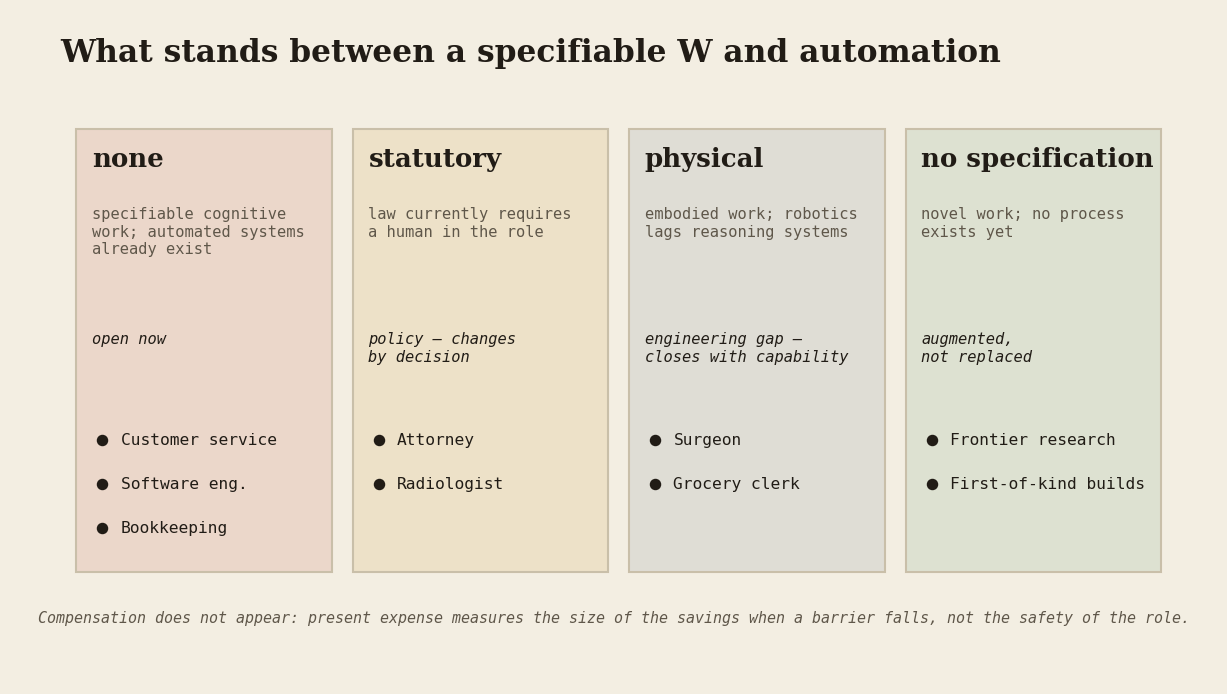
Examples. An attorney's specifiable work sits behind a statutory barrier, which is a property of law rather than of the work. A surgical role sits behind a physical barrier, and its cost funds the robotics that close the gap. A software engineering role sits behind no barrier at all.
A separate category is work that cannot be specified because no process for it yet exists. This is not U. U is a gap in O's specification of the business's existing work. Here there is no process for anyone to specify. Such work is augmented by automation rather than replaced. A practical test: if existing references are sufficient to perform the task, the task is specifiable and does not belong in this category.
Specification
X and U sit on opposite sides of the same boundary. X is effect an individual produces outside the defined W. U is work inside W that O cannot yet specify. Specification is the movement that resolves both. An X specified by the individual becomes PX and extends W. A U specified by O or an architect becomes an ordinary P.
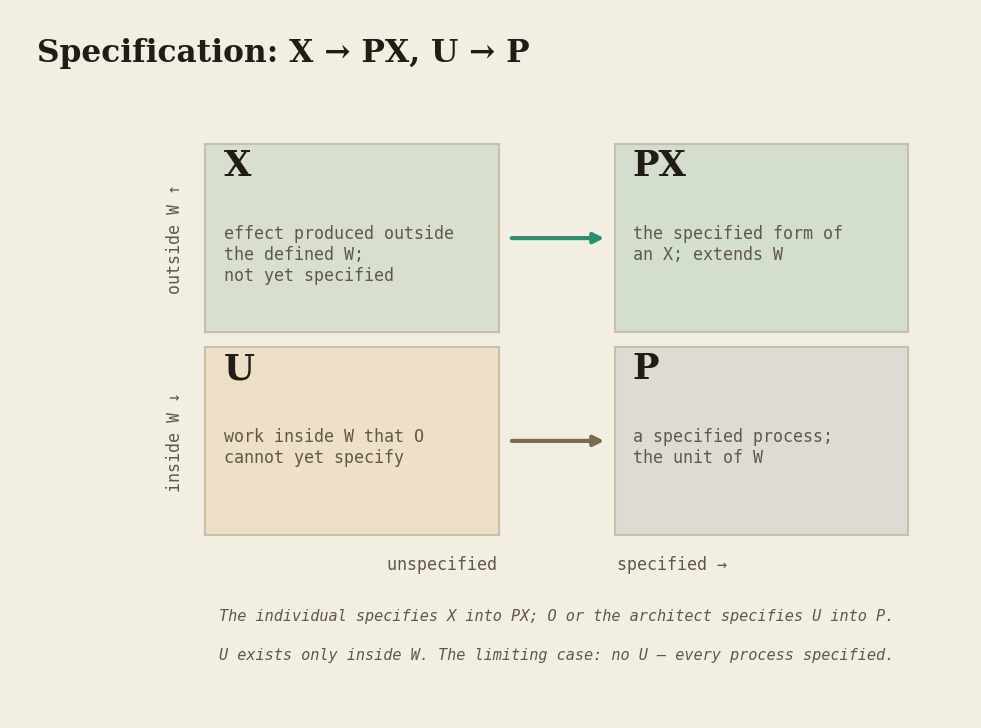
A specifiable process left unspecified is a cost to B no matter how expert it appears. Specified value can be improved, transferred, and automated. Unspecified value can only be accepted on trust.
PX is the mechanism of growth. An X converted into a specified process extends W, and once established it becomes a P. The framework identifies two recurring errors in practice: reducing X to lower variance, and treating low specifiability as evidence of value.
Restructuring (the architect)
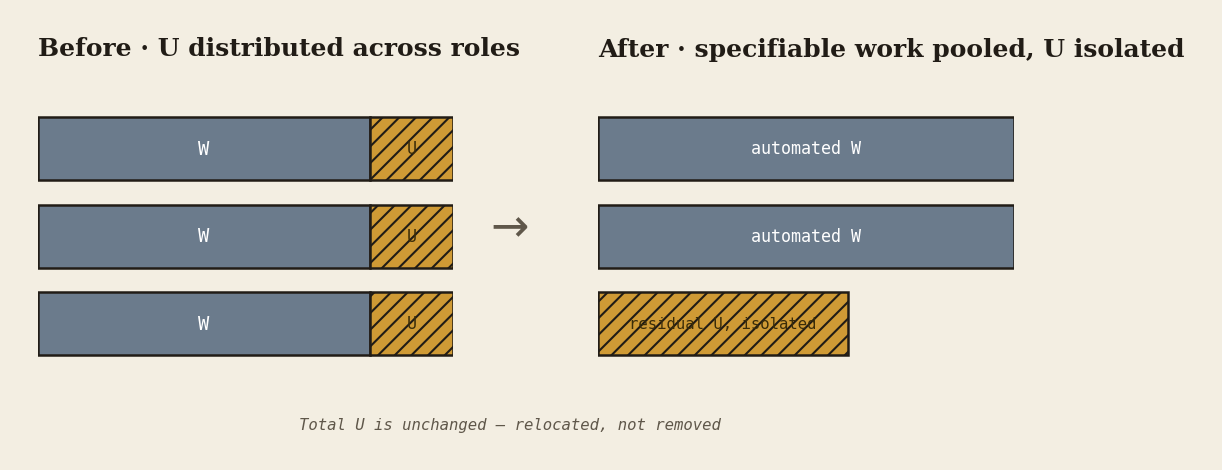
Restructuring W is performed by an agent acting in the O role, either internally or as an external competitor. This agent does not occupy a role and therefore has no X. Restructuring does not remove U. It relocates it. Specifiable work is consolidated into automatable units, and the residual U is isolated for inspection. Total U is unchanged until the underlying work is specified. Two methods are available: specifying a process directly from available data, or automating the specified portion and observing the remainder. This role may be termed the architect.
Part III: Attribution of value
Part III concerns the relationship between the individual and the owner, and the conditions under which value is attributed correctly.
Misattribution of value
A recurring error is to evaluate an individual by W rather than by effect on B. Evaluating by W means measuring output relative to peers in the same function. Output within W is largely independent of effect on B, because most of a business's value originates outside any single W. As organizations grow, effect on B becomes harder to measure, and W output substitutes for it.
Example. An order picker who fills three times the orders of a colleague has higher output, but not necessarily greater effect on B. Where the day's orders ship by the carrier cutoff regardless, the additional speed is slack. If the faster picker leaves and the others still meet the cutoff, B is unaffected. It may even be improved, since the same function now costs less.
Example. A testing lab has a regulatory reporting window of 24 to 48 hours and meets it with a single analyst at a normal pace. Additional staffing to clear the queue faster raises cost without raising effect on B. The requirement is the regulatory window, not an empty queue.
Automation makes the distinction explicit. A business is required to establish the value of the W, not of the individual. Where W can be performed by an automated system, the value of an individual beyond their W is posed as a direct question, and the burden of demonstrating it falls on the individual.
Degradation of W-based structures
Historically, filling a role was a choice among individuals. W operated as a threshold, and the choice among those who cleared it was made on profiles of X and R that could not be known in advance. Every option also carried some U, meaning some part of the work the owner had not specified, and that U was accepted as a cost of delegation. The ambiguity was structural, so it was priced in rather than resolved.
An automated alternative changes the structure of the choice. It carries no bundle. There is no unknown X, no unknown R, and no U. Accepting ambiguity becomes a decision rather than a constraint. Where a role's W is specifiable, the incentives split. An individual whose security depends on the owner being unable to specify the work has a reason to keep it unspecified. The business's reason runs the other way. The framework treats holding U as the characteristic failure of W-based structures rather than a strategy. It is a defense that lasts only until the work is specified.
Division of function between owner and individual
The model implies a division of function. O's function is to enable X by providing the conditions under which individuals produce effect on B beyond their W. The individual's function is twofold: to generate X, and to specify it as PX so that O can evaluate and retain it.
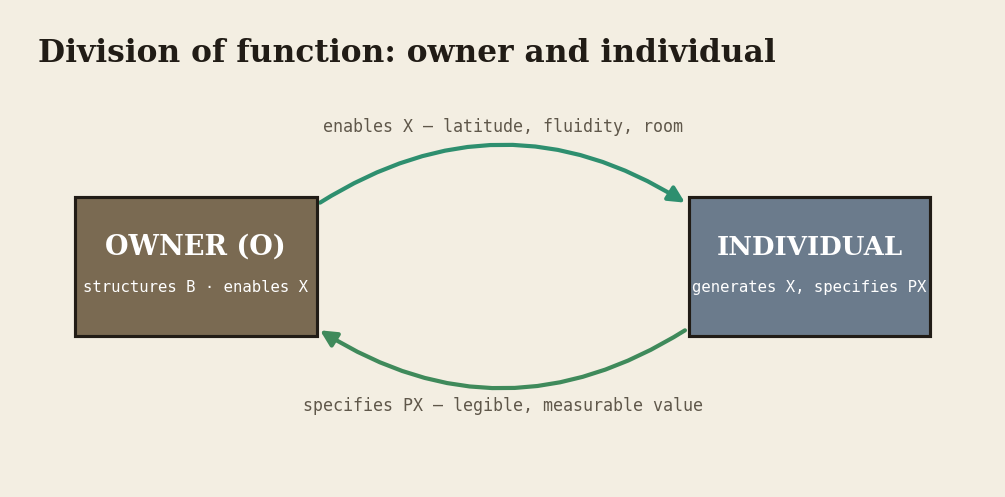
As data and measurement capability increase, X becomes easier both to generate and to specify. The constraint that historically favored W diminishes. The model identifies X specified as PX as the position least exposed to automation. It also notes a tendency toward owner-type roles, since smaller and fully specified systems permit more accurate attribution of value.
Part IV: Application
Part IV applies the framework in two directions: a business examining its own model, and an individual evaluating a role.
Examining the business model
For an owner, the framework's first use is diagnostic. It asks for the business's model to be broken into its actual steps: what concretely produces the money, or for a mission-driven organization, what produces the outcomes it exists for. Each step can then be read in the framework's terms. Which steps are specified processes. Which are performed but unspecified, which is delegated U. Which depend on work that cannot yet be specified at all. Only with that map does the automation question become answerable, because it is really two questions: whether a step can be automated, and whether it should be.
The map also works in reverse. Example. An automation effort underperforms. The framework supplies the first diagnostic question: was there a part of the process that was never actually specified, meaning U the specification missed, or does the cause lie elsewhere? The framework does not answer the question. It makes the question precise enough to ask.
Scoring a role
A role may be evaluated by its idealized W, X, and R. This is the potential of the role, independent of its current occupant. The relevant quantities are two. The first is the specifiability of its W, which is what automation can reach once barriers fall. The second is its X ceiling, the maximum effect on B reachable outside W. A role with high specifiability and a low X ceiling has limited capacity to sustain a position. Every role admits some X. Not every role admits enough to sustain a position. Barriers, whether statutory or physical, do not appear in this scoring. They set timing, not value.
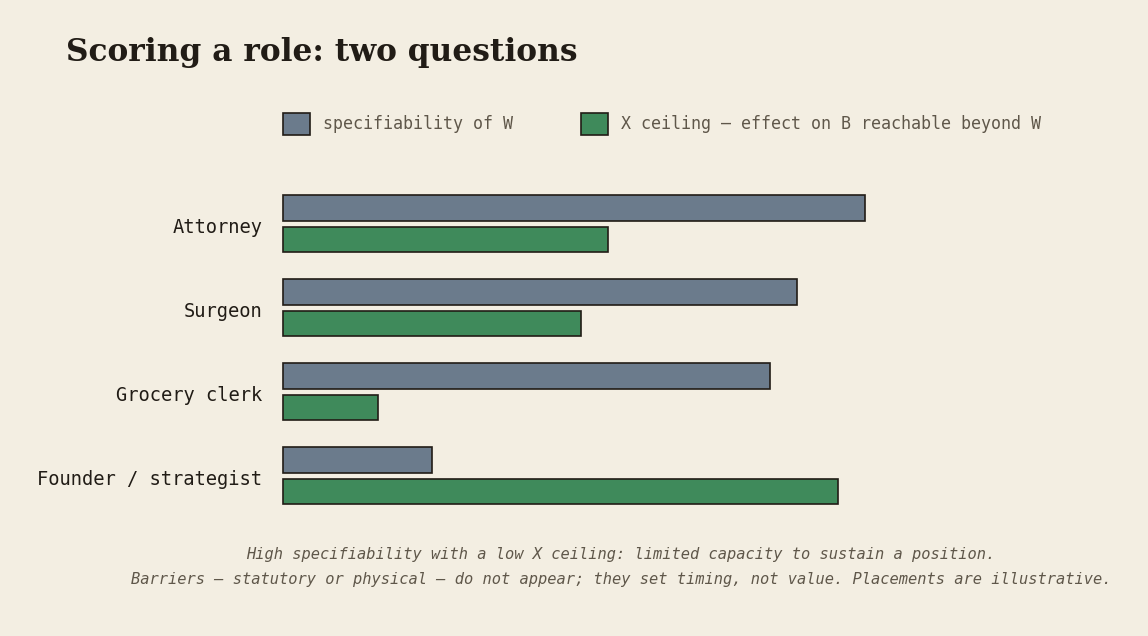
Example. The legal profession includes a credentialing layer of licensure and training that is not itself effect on B. The specifiable component of the work is assembling supporting material and presenting an argument, and that component is reducible to process. Licensure functions as a barrier rather than a measure of value, and a barrier defined by statute is subject to statutory change. The difficulty of the work does not prevent specification, because experienced practice is itself a refined process.
The reachable position
The scoring above asks the reader to set barriers aside. This conclusion is read the same way. Barriers decide when the comparison arrives for a role. They do not decide how it resolves once it does.
Defending W against automation is unstable. Holding U is the same defense in another form. It protects a role only while the work stays illegible, and only until the work is specified. The position the framework points to is simple, create positive effect on B that did not previously exist. The criterion is open by construction, like X itself. The framework prescribes no domain, no tooling, and no method. What it requires is that the effect be verifiable, because verifiable effect on B is the only thing an individual is finally measured against. That is true above all at retention, when the estimates of X and R have given way to observation.
Example, taken to an extreme to isolate the criterion. An individual offers a business an additional $500,000 in annual value and asks to be paid $100,000 of it. The effect is demonstrated and attributed to the individual irrefutably. The method is not visible to O. The owner accepts, because the value exchange itself is verified. The opacity of the method is not a bar to retention. It is a residual R to be priced, covering questions of legality, dependence, and ethics. The point of the extreme is that the binding criterion is verified effect on B, not legibility of method. Specification, meaning PX, remains the strongest form of demonstration, because a specified process survives, transfers, and compounds. But it is a means of verification, not the criterion.
On the owner's side, what automation changes is the reach of ownership. Organizations are built on delegated trust. O cannot hold every process, so layers attest to one another. A manager's account of an individual is accepted unless O can verify otherwise. U is the residue of that structure, priced in as the cost of scale. Automation extends what O can verify. Processes can be specified, instrumented, and held directly. O can own the workings of the business rather than trust descriptions of them, including the parts where O has no expertise and no direct involvement. The abstraction existed because the whole was too complicated to hold. Removing that constraint is exactly what phases automation in, and the layers that existed to be trusted are the layers that thin.
This sets the terms of the fork. Under a structure that recognizes only W, the comparison between an individual and an automated system runs on the machine's terms. The option that is cheaper and carries less R wins, and an individual does not win a contest of being the better machine. The same fact that loses that contest also produces X. A person exists outside the process, with costs and interests the process does not contain. The alternative structure is one in which individuals can express, and owners can verify, effect on B beyond W. The framework's closing claim is conditional. Retain the first structure and the displacement is general. Build the second and the comparison itself changes. If the contest is being the better machine, the contest is already lost. The remaining move is to change the game.
The broader aim of the framework is to describe where value originates and to identify which forms of work remain reachable as automation advances. It does not assert that individuals retain value by default.