If you have not read Worth More Than the Work, read it first. Much of what follows depends on the variables it introduced. Here is a short recap for anyone who needs it.
- B (Business). The complete system under analysis: the set of its job functions. B = ΣW.
- O (Owner). The agent that defines the structure of B, including the division of work into processes.
- W (Work, job function). The set of processes that constitute a role, specified independently of any individual who performs it. Execution quality is not part of W. W = ΣP.
- P (Process). A single specifiable business function: the unit of W.
- X (X-factor). Any positive effect on B that an individual produces outside their defined W.
- R (Risk). Any actual or potential negative effect on B attributable to an individual.
- U (Unknown). The portion of W that O cannot reduce to a specified process.
- PX (Process from X). A specifiable process formed from an X that did not exist in the current W.
The crossroads
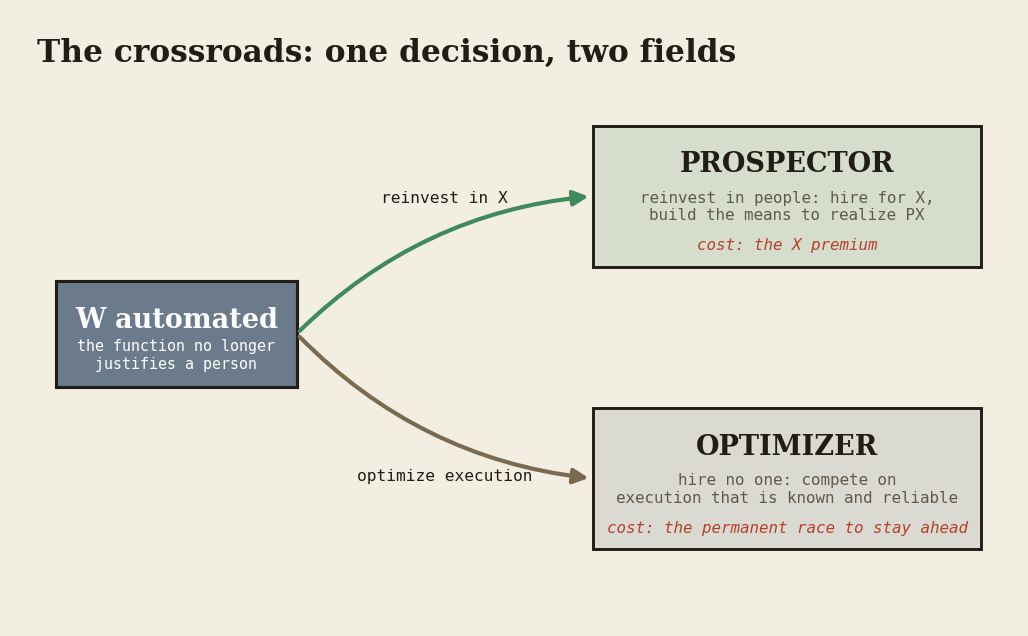
The first article ended at a fork. At some point the execution of a function no longer justifies a person, on either cost or risk. Once that is true for most of a business's W, the owner has to choose. There are two coherent answers, and they do not sit on the same field.
- Automate W and reinvest in people. Hire directly for X, and build the business around producing X and holding R down.
- Automate W and hire no one. Compete on the cost and reliability of execution itself.
I will call the first group Prospectors and the second group Optimizers.
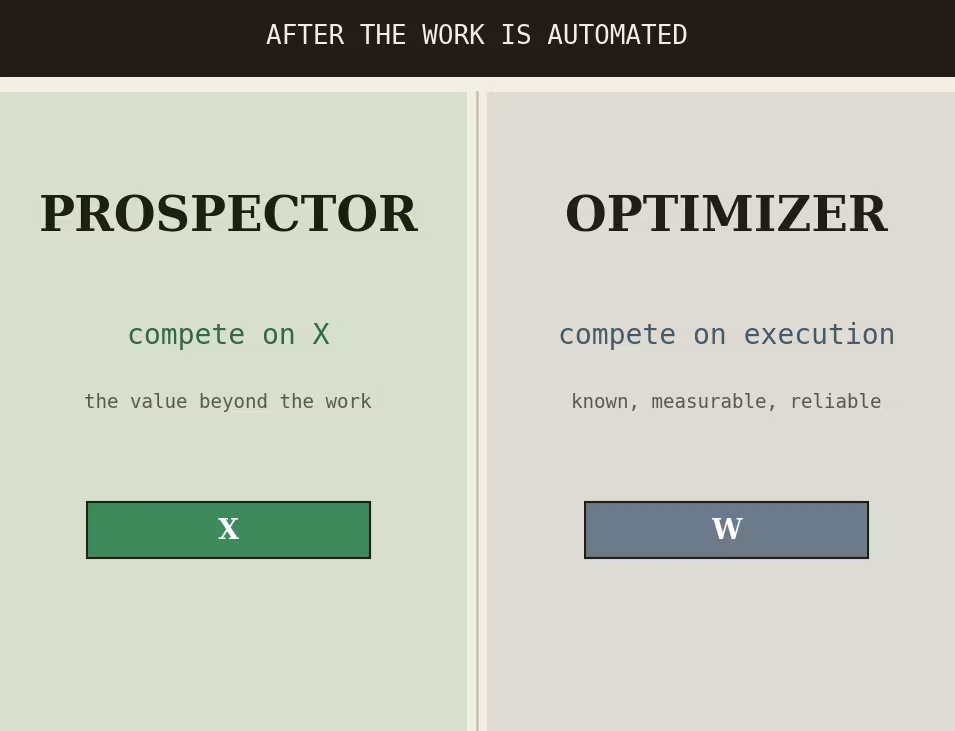
A Prospector resembles the strong horizontal organizations of today. You are not hiring to fill a process(W). You are searching for people who produce outsized effect on the business, and building ways to turn that effect into something the business keeps. In the variables, a Prospector hunts for large X and for the ability to convert it into PX. Finding that value and realizing it is the work of the business.
An Optimizer competes on known variables. Price, cost, reliability. The model is to deliver the same value as everyone else for less, or more dependably. This is why an Optimizer avoids hiring. A hire is a cost, and the moment you carry a cost a competitor does not, they can price below you on the one axis you both compete on. So the Optimizer drives the cost of execution down and works to keep it there. That requires the most effective and accurate orchestration in the market, which means staying current on the methods and getting steadily better at the data they run on.
A note on the word market, since it runs through everything here. Each business decides for itself how it competes and who it competes against. With cheap data and a low barrier to novelty, we may see new markets form, and businesses able to niche down completely. That deserves its own article, so I will leave it here.
Where we stand today
Look at how businesses are adopting AI right now and most are doing neither of these things, or some blend of both. My claim is that continuing today's patterns will produce bad outcomes. Here is why.
At a small scale, the benefit of automating W is the cost saving. It lets you make a better offer than your competitor. At a larger scale, the benefit is freeing people up, so you can move that human capital toward growth or toward producing PX. That is not what most businesses are doing.
Many are handing employees AI tools and hoping it keeps them a step ahead. Others are cutting headcount in an uncertain economy and keeping only the people who execute the core function. That is hedging, not growth. And it does not hold for long, because almost everyone outside the frontier labs has the same models and the same methods. For a large company, your competitors are running the same tools you are, in slightly different arrangements. Cutting people in order to spend on AI buys no lasting edge when the AI is the same AI everyone else can buy.
What AI actually changes
The real change is measurement. Our problem was never the number of data sources. It was having a way to make sense of them. We leaned on dashboards and summaries built from methods we had to know to ask for. AI changes what we can see. It can read across a business's data and tell us, after the fact, what produced an effect and who was involved.
This needs to be separated from the first article carefully. Before you hire someone, X and R are not measurements. They are buckets. They hold the things that might happen, good and bad, that you cannot know in advance. After you hire, they become real only when the business feels them. A hire who turns out to be dishonest was a possibility sitting in R the day you brought them on. The cost becomes real on the day the business feels it, and from that point it can be attributed. The claim is not that you can predict a person's value. It is that once their effect lands, you can see it.
That changes what you can do with pay. Instead of guessing how much each person contributed, or paying the market rate for their title, you can pay closer to the effect they actually had on the business. Think about how sales already works. You take a commission on what you close. The same idea can extend to any role once the effect is visible. It is also what lets a team stay fluid, because you are paying for value produced rather than for a seat.
It reframes management too. Ask why most roles need managing at all. Largely because no one could connect a person's day to day behavior to the business's results, so we hired people whose job was to make that judgment by hand. Management is what you build when you cannot see impact directly. When you can see it, you need less of that scaffolding.
The X premium
All of this raises an obvious question. If you can pay people for the value they produce, why not hire everyone who produces more than they cost?
The answer is R, and the overhead that comes with people. Every hire carries cost and risk that has nothing to do with their X. There is the cost of finding and assessing them. There is coordination, which grows with each person you add. There is the risk they walk out with proprietary information, or harm the business in one of the ways you only priced as possible before they arrived. X never comes on its own. It arrives attached to a person, and a person arrives attached to R.
This is the cost of being a Prospector, and it is worth naming, because the rest of this series will come back to it. I will call it the X premium. It is the waste and risk a business accepts in exchange for access to X. A Prospector competes by accumulating X, and X only arrives bundled with R, so a Prospector runs at a higher floor of cost and risk than an Optimizer who hires no one. That floor is the premium. You do not get the upside of people without paying it.
One caution. The X premium is a property of the strategy, not a number you compute per hire. You know you are paying it. You do not know exactly how much. The moment you try to pin it to a figure, you are back to pretending you can isolate and price a person before the fact, which is the thing we just said you cannot do. A Prospector accepts the premium as the cost of the field it chose.
Choosing a field
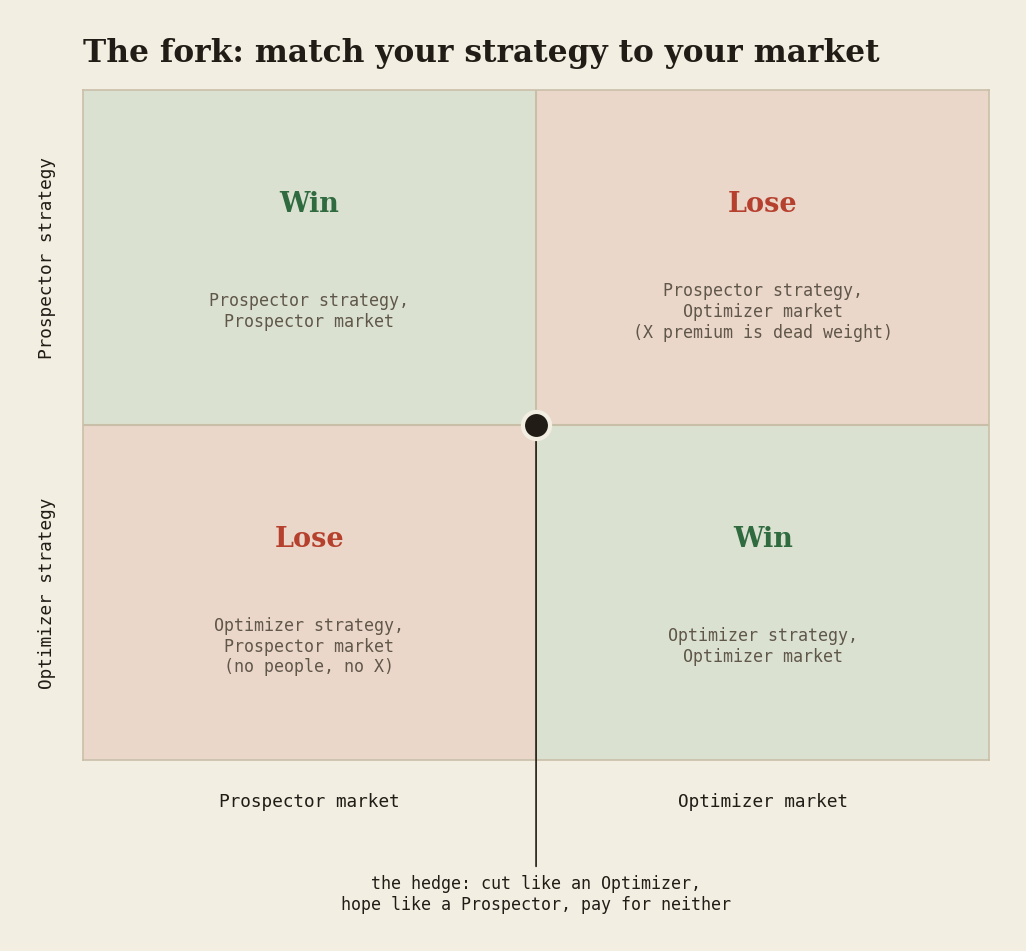
This brings us back to the fork, and to the mistake I think most businesses are about to make. The two strategies are not interchangeable, and they are not on the same field. A Prospector competes on the size of the value its people can find. An Optimizer competes on the cost of doing a known thing. Each one pays for its position. The Prospector pays the X premium. The Optimizer pays in its own way, through a permanent race to stay the cheapest, because the day a competitor's execution costs less, the Optimizer loses on the only axis it has.
The danger is choosing the wrong field. Try to be a Prospector in a market that rewards Optimizers and you lose. You are carrying the X premium, paying for access to upside, in a market where no one is paying for upside. They are paying for price, and your premium is dead weight your competitor does not carry. The reverse is just as fatal. Try to win on novelty as an Optimizer and you had better have genuinely novel methods of optimization, because ordinary novelty comes from people, and people are the cost you refused to take on. An Optimizer reaching for breakthroughs without a real edge in how it optimizes is just a Prospector that forgot to hire anyone.
Most businesses today have not chosen at all. They are cutting people like an Optimizer while hoping for growth like a Prospector, and paying for neither position properly. That is the hedge. It feels like the safe move. It is the one move on the board that loses on both fields at once.