- B (Business). The complete system under analysis: the set of its job functions. B = ΣW.
- O (Owner). The agent that defines the structure of B, including the division of work into processes.
- W (Work, job function). The set of processes that constitute a role, specified independently of any individual who performs it. Execution quality is not part of W. W = ΣP.
- P (Process). A single specifiable business function: the unit of W.
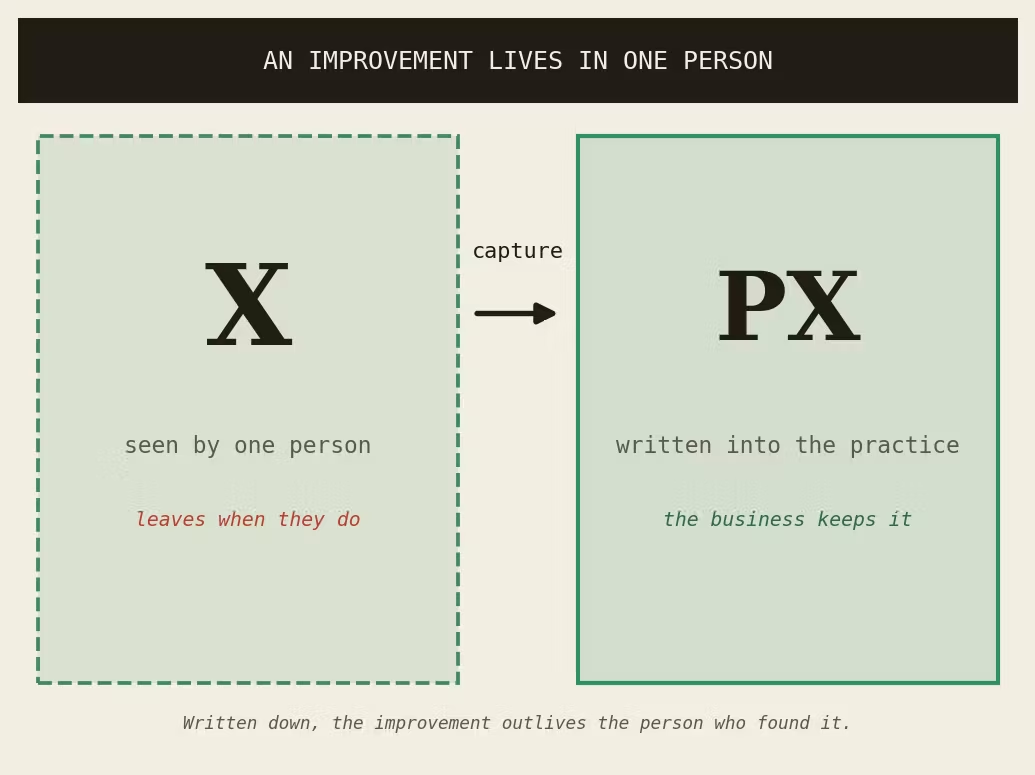
- X (X-factor). Any positive effect on B that an individual produces outside their defined W.
- R (Risk). Any actual or potential negative effect on B attributable to an individual.
- U (Unknown). The portion of W that O cannot reduce to a specified process.
- PX (Process from X). A specifiable process formed from an X that did not exist in the current W.
The X in detail
In the earlier essays I defined the X as any positive effect on B that an individual produces outside their defined W. I wrote this one to take that definition apart in more detail, because the X is the concept the whole framework turns on once you start thinking about how to structure an organization.
I will start with an example, built to show both an X and a PX in motion.
Without a vehicle for X
You hire a customer support representative. Six months in, they are posting higher satisfaction scores and noticeably shorter call times than anyone else on the team. The support manager brings them in and asks what they are doing differently, hoping to lift everyone else's numbers. The rep is not really sure how to answer. They say they just try to be friendly and get to know the customers, and the manager nods along. Maybe the rep is simply likeable, and that smooths out every call. He files them away as a strong performer with room to move up.
With a vehicle for X
You hire a customer support representative. This time you have explained the standard practices of the role up front, the metrics they will be judged on, and the company's larger goals and pain points. You have also made one thing clear: improving any standardized process earns a raise tied to what that improvement is worth to the business.
Six months in, the same pattern appears. The rep is posting higher satisfaction scores and shorter calls than anyone else, and when the manager calls them in, they are ready. They have documented their method, because they are hoping it earns the raise they were promised. What they found was that mapping customers by account type and the records tied to each one, then logging every issue by customer, let them spot recurring patterns and skip the verification and context-gathering that used to eat the first minutes of every call. The result was a 30% drop in call time and a 40% rise in satisfaction.
The manager and the rep then model the rollout together, using AI to estimate what the method would save across the whole team if everyone adopted it. After a review, the rep receives a raise that reflects that estimate. The method itself goes into the standard practices, passed on to the rest of the team and to every future hire. And because the rep was actually paid for the improvement, they start looking for the next one. They have begun to think past their role and into the business.
It is worth heading off one objection here, because it cuts to what X actually means. Someone will say the rep was just doing the job well, and that improving your own role is part of the role. But a friendlier, faster call is elevated execution, and execution is not X. The rep did something different. They produced an improvement that originated outside the standard practice, and then they specified it. Written down and handed to the next hire, that method is a process the business did not have before and now owns. That is PX. The test is simple. If the improvement can be written into the standard practice and passed on, it changed W and it was X. If it cannot, it is either execution, which leaves nothing behind, or an X still locked in one person's head, which leaves when they do.
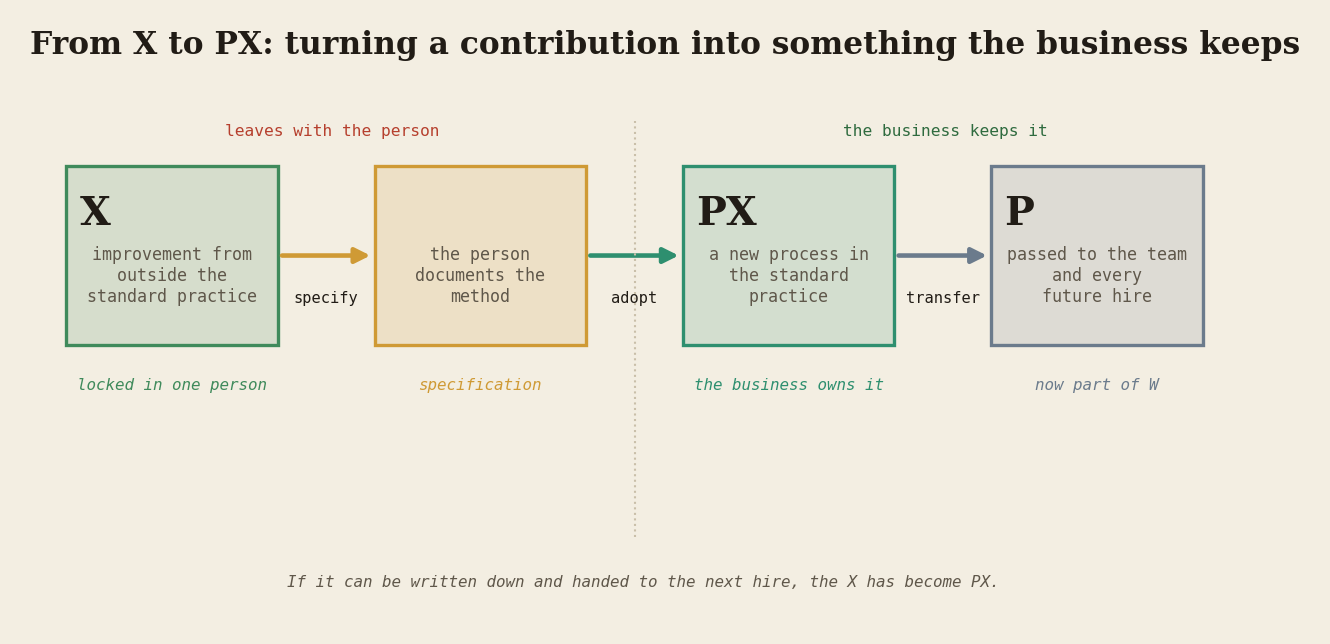
The first example is simpler than reality would be, but it makes the point. What do we see when the two sit side by side?
Some readers will say the first manager is simply bad at his job, that a better one would have caught the process difference himself. Others will say the strong performer was being cagey, holding information back from his boss (protecting themselves with U). The most interesting objection is the third: if the business could find the improvement on its own, by analyzing employee data and behavior, it could save the money and skip paying anyone for it.
Now the business probably could reconstruct the method that way. One of the benefits of AI is synthesizing micro patterns with company data. But doing so may be the worse move, and seeing why is an important observation of this essay.
Start with what it costs. Mining your own data to recover an improvement saves the money you would have paid the employee, but it spends the one thing the owner cannot make more of, which is their own attention. Every hour spent reconstructing a method from behavioral logs is an hour not spent on the work only the owner can do. The rewarded version converts that time problem into the employee's incentive to hand the value over already packaged. You pay money to save attention. Protecting the money while treating owner attention as free is exactly the inversion that marks an Optimizer (see Prospectors and Optimizers).
The deeper cost is what the choice teaches. A business that takes X by surveillance rather than reward has announced what it is. The employee learns that producing value beyond the role gets absorbed without compensation, and the rational response is to stop producing it, or to stop making it visible. You have not just declined to pay for this one improvement. You have trained the workforce out of generating the next one. The loss is not the method you grabbed for free. It is every method you will never see, because you taught people that visibility is a tax.
And it compounds. One extracted improvement looks like a win on the quarter. The damage is a slow attrition of the exact behavior a Prospector exists to cultivate, and it surfaces quarters later as a workforce that executes and does nothing more. The move that optimizes the present destroys the X-generating capacity that was the whole reason to keep people. Why would an employee change anything if changing it earns them nothing? Over a long enough run, they will not, and the innovations you would have captured never arrive.
A shared responsibility
What I am arguing is that the vehicle for capturing an employee's contribution does several jobs at once, and that building it is a shared responsibility. The business is responsible for allowing X to exist, so that it can be converted into PX. The employee is responsible for capturing that X in a form the business can actually use and trade for value. The whole arrangement runs on an incentive structure.
Look at the first example again. The manager has an employee posting strong numbers, which is good for the manager too. He is probably handing out praise, or at least staying out of the way. In both examples the employee produces outsized returns. The difference is where the employee believes that value comes from. In the second example it comes from the improvement they made to the business. In the first it comes from looking better than their peers. And if your value comes from comparison to your peers, why would you ever help your peers improve? The incentive points the wrong way, and the employee has every reason to keep their method to themselves, because sharing it works directly against them.
The second example gives the employee a formal way to capture PX, and one they can actually reach. The incentive is defined ahead of time, so they know what the upside could be, and they understand the business itself, because the model was explained to them and the existing processes were spelled out. Once an employee is rewarded for this kind of contribution, it builds a culture of improvement, one where people think past the execution of their own task and toward the business as a whole.
Most employees hold back because they assume they will not be paid for going beyond the process, and might even be punished for stepping outside it. And plenty of organizations would rather not build formal training or show employees their real value, because they fear it opens the door to constant pay negotiations.
What can actually be measured
Two different things happened in that second example, and they do not belong in the same category. The first is the local effect: a 30% drop in call time and a 40% rise in satisfaction, with proof that the new method caused them. That is a counted result. It is real, it is attributable, and it sits in the same category as a salesperson closing a certain number of deals.
The second is the figure the raise was tied to, the value of rolling that method out across the entire team. That is not a counted result but an estimate. You are taking the local effect, projecting it across more people and forward in time, and subtracting the costs the projection cannot fully see.
This is the part that tends to get misread, so it is worth slowing down. Think about how a sales commission already works. A salesperson is paid on the deals they close, which is a counted number, but that commission was never the same thing as their true worth to the business. Someone can close more than anyone else by overselling what the company can actually deliver, and still turn out to be a net negative once the refunds and the lost trust come due. Did that person still get paid? Yes, because they were paid on an agreed proxy, not on verified value. The business accepted in advance that the proxy and the truth might diverge, and that gap is R.
So the point is not that you cannot measure contribution. You can measure the local effect well enough to reward it. The point is that the reward attaches to an estimate both sides agree to up front, the way a commission rate is agreed before anyone knows what a year of selling will look like. The employee is paid on estimated value, not on value verified to the dollar, and everyone knows it.
What AI changes is not that the estimate becomes perfect, but that it gets better: tighter, faster, and closer to the actual effect on B.
When AI takes the W
Now return to the world where AI takes all of the W, the specified work.
Take the same example, except that no one needs to staff the support line at all. The whole function now runs for a small fraction of what the employees used to cost. If the hire cannot perform the support function, what are you paying them for? And how do they earn anything once every company absorbs that function the same way?
In the first example, there is no answer. The rep is let go, and the manager with them, because there is no one left to manage. In the second example, the rep already has a record of process improvements that verifiably helped the business, and they turn to helping the company fold those improvements into the automated system. The manager's role changes rather than ending. It becomes a matter of facilitating resources, answering questions about the business, unblocking X, and judging where people and money should go.
None of this means people should be turned loose without structure. It means the structure should be built the other way around. Instead of training people to behave like machines, we should be building organizations fluid enough to absorb the X that people produce, and to turn it into something the business keeps.